

A moving CRM doesn’t just manage contacts – it becomes the backbone of dispatch, billing, storage, payroll, and reporting. If you’re evaluating MoversTech and SmartMoving, you’re likely comparing two of the more established moving-specific CRM platforms on the market.
MoversTech and SmartMoving are both built specifically for the moving industry, supporting operations from lead intake to dispatch, documentation, payments, storage, and reporting.
This comparison focuses on how each platform structures those capabilities – and where their operational models differ – so you can evaluate which approach better fits your business.

Estimating and inventory control
Both systems allow customers to complete inventory online, with information flowing directly into the CRM. Both platforms also support automated estimating based on predefined tariff structures to ensure pricing consistency.
The distinction lies primarily in how the customer journey and internal workflows are structured.
SmartMoving centers its experience around a standardized customer portal. The portal consolidates inventory, estimates, and documents in one centralized location, providing a consistent and structured process with limited configuration.
MoversTech approaches the process from a workflow-automation perspective. Instead of relying on a single fixed portal structure, it enables companies to build configurable automated sequences – including email and SMS communication – aligned with their specific sales and operational flow.
For example, a new lead can automatically receive an inventory form, followed by a quote, followed by a contract. Each step can be triggered based on timing, status changes, or internal logic, with customization available for messaging, document design, and sequencing.
In practice, this means:
- A portal-driven model emphasizes centralized visibility and standardized structure.
- A workflow-driven model emphasizes operational flexibility and process customization.
Companies that prefer a predefined, centralized portal experience may find the portal-based approach suitable. Those that prioritize adaptable workflows, configurable automation, and alignment with unique internal processes may prefer a more sequence-driven system.

Dispatch and crew management
Dispatch is where planning turns into execution.
Both MoversTech and SmartMoving provide dispatch tools, crew coordination, and mobile applications for field teams. In both systems, crews can access job details through dedicated mobile apps (iOS and Android), clock in and out, and automatically generate payroll data based on recorded hours.
The difference lies in how dispatch visibility and workflow structure are presented.
SmartMoving offers an advanced drag-and-drop dispatch board designed for detailed crew and truck allocation. It emphasizes visual resource management, including occupancy tracking, conflict detection, and structured assignment control. This approach provides a highly operational view with built-in safeguards and a scheduling structure.
MoversTech focuses on clean operational calendars available in daily, weekly, and monthly formats. Companies can customize which information appears on the dispatch view, adapting the layout to match internal workflows and reporting preferences. The emphasis is on clarity, configurability, and operational overview rather than a fixed dispatch board structure.

In practical terms:
- SmartMoving emphasizes detailed resource allocation and structured scheduling controls.
- MoversTech emphasizes customizable visibility and adaptable calendar-based planning.
- Both platforms provide mobile crew apps with time tracking and payroll automation.
For companies that prefer a highly structured dispatch board with built-in allocation controls, a drag-and-drop model may feel more aligned. For those that prioritize customizable visibility and flexible operational layout, a configurable calendar-based system may be a better fit.
Interface structure and ease of use
Ease of use directly impacts adoption, onboarding speed, and day-to-day efficiency.
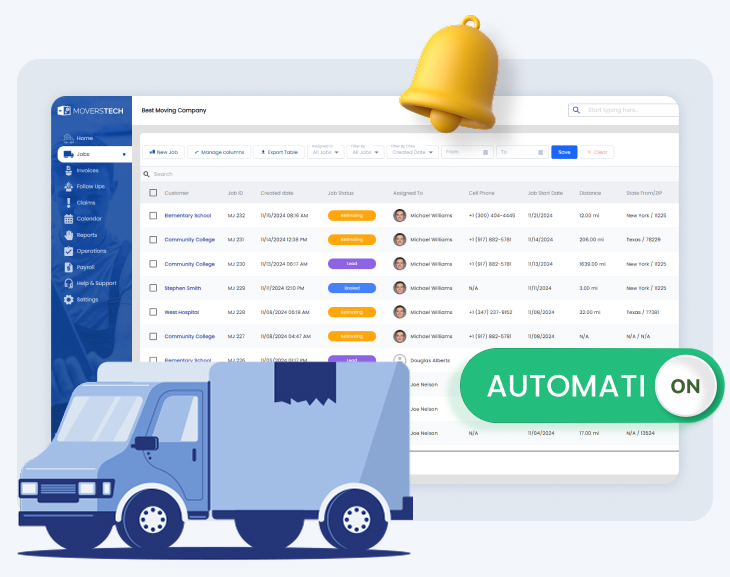
MoversTech emphasizes interface clarity and configurability. System views can be customized at a granular level – including job statuses, field names, field types, and layout structure. In list views such as the job board, companies can add or remove columns, rearrange their position, and surface only the information relevant to their workflow. This allows the CRM to reflect internal terminology and operational logic rather than forcing teams into predefined labels or fixed layouts.
The interface is designed to remain consistent and responsive across devices, with layouts optimized for desktop, tablet, and mobile environments. This ensures that coordinators, managers, and field teams experience the same structured clarity regardless of device.
SmartMoving provides a more structured and module-driven interface. Its system includes detailed operational controls distributed across multiple views and tabs, reflecting a framework-oriented design. This structure can offer depth and clearly segmented functionality for teams that prefer predefined modules and system-driven organization.
In practical terms:
- MoversTech emphasizes configurable layouts, field-level customization, and adaptable views.
- SmartMoving emphasizes structured modules and segmented operational controls.
The preference often depends on whether your team values interface adaptability aligned to internal processes or a predefined framework with layered operational depth.
Integrations and API access
Integrations determine how well a CRM connects with the rest of your operational ecosystem.
Both SmartMoving and MoversTech provide integrations with commonly used tools in the moving industry, including accounting software, email platforms, calendars, mapping tools, VoIP systems, and third-party lead providers. Both platforms also offer payment processing with competitive and comparable transaction structures.
SmartMoving highlights integrations with platforms such as QuickBooks, Mailchimp, and RingCentral, and provides API access for companies requiring deeper system connectivity or custom integrations.
MoversTech integrates with tools such as QuickBooks, Google Email and Calendar, JustCall, and website or lead-provider APIs. It also provides open API access, allowing external systems to send and receive structured data as long as formatting requirements are met.
Both platforms allow companies to connect their own email domains for client-facing communication, ensuring branded outbound emails and centralized communication tracking. Both systems also include integrated texting functionality, enabling SMS communication directly within the CRM environment.

In practice:
- Both platforms support third-party lead imports.
- Both offer API access for custom development needs.
- Both integrate with major accounting, communication, and mapping tools.
- Both support online payments through integrated processors.
- Both support branded email domain integration and in-platform SMS communication.
MoversTech places particular emphasis on adaptability – working with partners or internal teams to align data structures when needed, and offering customizable web forms for companies that require embedded lead capture without dedicated development resources.
If integrations are critical to your operation, the evaluation should focus less on the number of logos listed and more on API openness, data flexibility, branded communication control, and how reliably systems connect to your workflows.
Pricing, plan structure, and feature availability
Both MoversTech and SmartMoving use tiered subscription models, with functionality expanding at higher plan levels. The meaningful distinction lies in when certain operational capabilities become available.
For example, accounting integrations such as QuickBooks and structured sales automation tools are introduced within SmartMoving’s Growth plan, while comparable workflow automation, dispatch tools, API integrations, and crew access are already available at an earlier plan level within MoversTech.
At the same time, advanced operational modules – including structured storage workflows, payroll management, and advanced reporting – are included within higher-tier plans on both platforms.
When evaluating pricing, it’s important to assess:
- What functionality is included at your starting plan level
- Which tools require upgrading to a higher tier
- Whether messaging, payment processing, or usage-based fees apply
- The length and structure of the service agreement
- How renewals and pricing adjustments are handled
MoversTech operates on a month-to-month subscription model with automatic renewal unless canceled, without mandatory long-term commitments. This allows companies to reassess the platform at any point as operational needs evolve.
SmartMoving’s SaaS terms indicate that initial term length may vary depending on the agreement selected at purchase, with renewal provisions defined within the contract.
Because a CRM becomes embedded in daily operations, evaluating feature availability by tier and total cost of ownership, not just the base monthly price, is essential when selecting a platform.

Enterprise capability and operational fit
CRM fit is less about company size and more about operational complexity.
Both MoversTech and SmartMoving are designed to support structured moving operations beyond basic sales tracking. This includes dispatch coordination, document management, storage workflows, payroll processing, reporting visibility, and multi-user environments with defined access roles.
MoversTech includes dispatch systems, claims management, recurring storage billing, payroll tracking, configurable reporting, and support for multi-crew and multi-location operations. Its structure allows companies to adapt workflows, layouts, and reporting logic to match their internal processes as operations expand.
SmartMoving also supports structured and multi-location businesses, with particular emphasis on built-in automation frameworks and predefined operational structures designed to guide execution at scale.
Instead of asking whether a CRM is “for small” or “for large” companies, more relevant considerations include:
- How complex are your internal workflows?
- How many crews, coordinators, and locations are you managing?
- Are storage, claims, or payroll part of your daily operations?
- Do you require configurable reporting or custom workflow logic?
- How much operational flexibility do you need as you scale?
Companies operating within standardized processes and seeking structured automation with defined operational pathways may find a framework-driven system aligned with their needs.
Companies managing evolving workflows, requiring adaptable reporting, or planning to refine and customize their operational logic over time may benefit from a platform built around configurability and flexibility.
Both platforms are capable of supporting growing and established moving companies. The practical distinction lies in whether your operation benefits more from structured guidance or from adaptable control as complexity increases.
Where the real differences show up
When comparing MoversTech and SmartMoving, it becomes clear that both platforms are designed to manage the full operational lifecycle of a moving company, from lead capture to dispatch, documentation, payments, storage, payroll, and reporting.
The distinction is not about feature presence, but about structure and operational philosophy.
SmartMoving emphasizes centralized portals, structured automation frameworks, and predefined operational pathways designed to guide execution within a consistent model.
MoversTech emphasizes configurable workflows, adaptable reporting, flexible dispatch visibility, and month-to-month contract flexibility, allowing companies to align the system closely with their internal processes.
The real differences show up in how much structural guidance versus operational flexibility your business prefers.
| Category | MoversTech | SmartMoving |
|---|---|---|
| Core Moving CRM | Full operational lifecycle (lead → dispatch → storage → payroll → reporting) | Full operational lifecycle (lead → dispatch → storage → payroll → reporting) |
| Estimating Approach | Workflow-driven sequences with configurable automation | Portal-centered structured customer experience |
| Inventory Collection | Online inventory integrated into CRM | Online inventory integrated into CRM |
| Dispatch View | Customizable calendar views (daily/weekly/monthly) | Drag-and-drop dispatch board with occupancy and conflict tracking |
| Crew Mobile App | iOS & Android, time tracking, payroll data | iOS & Android, time tracking, payroll data |
| Interface Customization | Custom field names, field types, views, layout and design control | Structured module-based interface |
| Integrations | QuickBooks, Google, JustCall, API access, lead APIs | QuickBooks (Growth), Mailchimp, RingCentral, API access |
| SMS & Email | Branded domain integration + built-in SMS | Branded domain integration + built-in SMS |
| Feature Availability | Key automation and integrations available at earlier plan levels | Certain integrations and automation unlock at the Growth tier |
| Storage/Payroll/Advanced Reporting | Included in higher-tier plan | Included in higher-tier plan |
| Contract Model | Month-to-month, no long-term commitment required | Term length varies based on the selected agreement |
Frequently Asked Questions
Are both platforms capable of running operation end-to-end?

Yes. Both MoversTech and SmartMoving support lead capture, estimating, dispatch, documentation, storage, payroll, payments, and reporting.
Which CRM offers more customization?
MoversTech emphasizes configurable workflows, customizable job statuses, field-level control, and adaptable interface layouts. SmartMoving emphasizes structured modules and predefined operational frameworks.
Are advanced modules like storage and payroll included?
On both platforms, advanced modules such as storage management, payroll processing, and advanced reporting are included in higher-tier plans.
What are the main pricing and contract differences?
MoversTech operates on a month-to-month subscription model with automatic renewal unless canceled. Companies can reassess at any time. It unlocks more advanced features, such as QuickBooks and api integrations, earlier. SmartMoving’s agreement structure may vary depending on the selected plan and contract terms.
How should I decide between the two?
The decision typically comes down to operational philosophy: Choose a structured, portal-driven framework if you prefer predefined system pathways. Choose a configurable, workflow-driven system if you want the CRM to align closely with your internal processes and terminology.
Reviewed by: Sam Hathaway
