
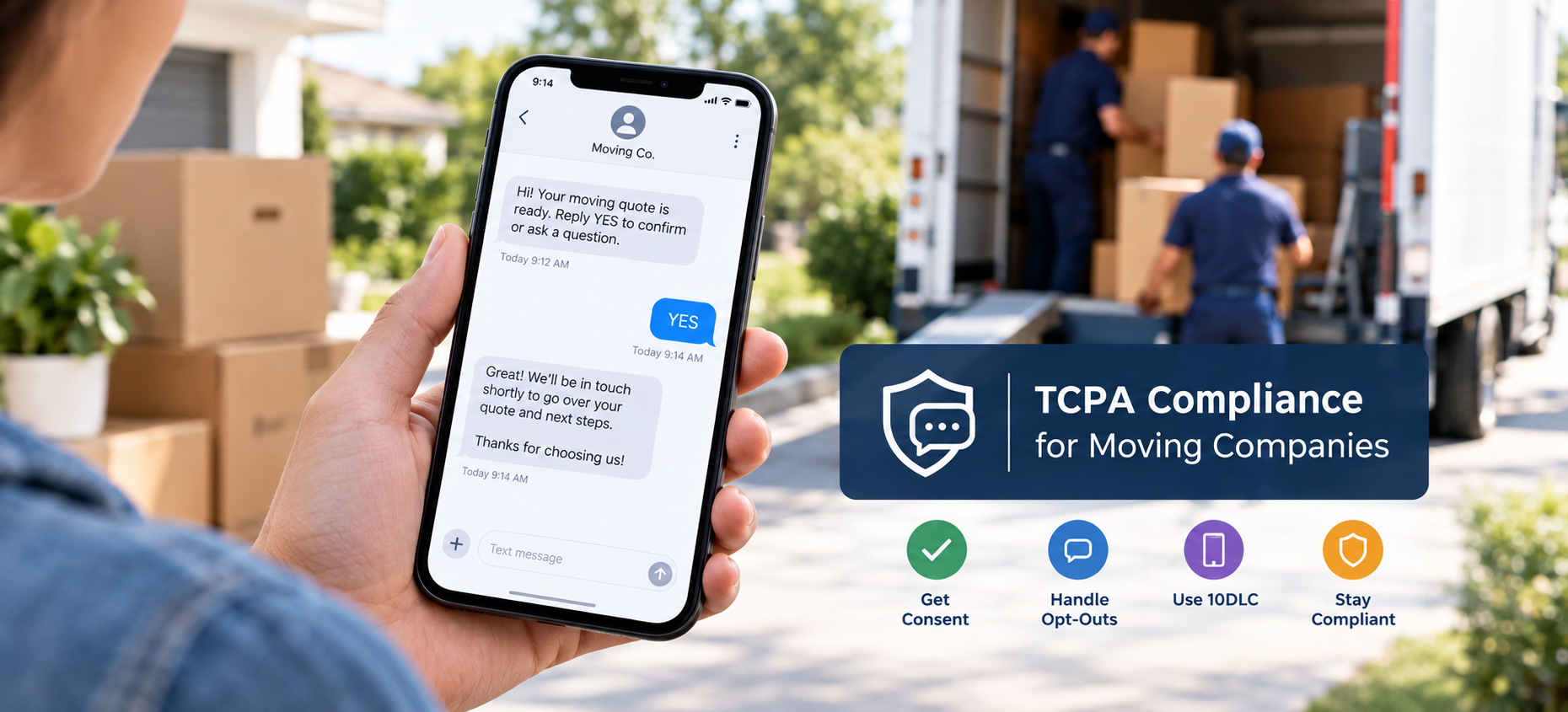
Moving companies can legally use SMS for quotes, reminders, follow-ups, and promotions, but the consent standard depends on the message and how it is sent. Marketing robotexts generally require prior express written consent, customers must be able to revoke consent, and businesses using local 10-digit numbers for A2P messaging should complete 10DLC brand and campaign registration through their messaging provider.
Texting is one of the fastest ways for a moving company to confirm a quote, follow up with a lead, or send a move-day reminder. It can also create compliance problems when messages are sent without the right consent or after a customer has asked them to stop.
That makes TCPA compliance for moving companies an important part of any SMS strategy. The rules are not identical for every type of text, but automated marketing messages generally face a higher consent standard than informational or transactional messages. TCPA violations can also carry statutory damages of $500 per violation, with courts able to increase damages to as much as $1,500 for willful or knowing violations.
This guide is for educational purposes only and is not legal advice. TCPA requirements can depend on how messages are sent, their content, and other circumstances, so confirm your specific setup with qualified legal counsel.
TCPA texting requirements for movers at a glance
| Requirement | What it means for a moving company | Good compliance practice |
|---|---|---|
| Prior consent |
|
|
| Written consent for marketing |
|
|
| Honor opt-outs |
|
|
| Process opt-outs promptly |
|
|
| 10DLC registration |
|
What is the TCPA and how does it affect moving companies?
The Telephone Consumer Protection Act regulates certain calls and text messages, particularly communications made using automated technology and messages involving advertising or telemarketing. The FCC has long treated SMS text messages as calls for purposes of relevant TCPA rules.
For movers, this matters because texting is built into the sales process. A company may text customers about estimates, appointments, arrival times, deposits, follow-ups, referrals, or seasonal promotions.
Those messages are not necessarily treated identically.
The biggest mistake is assuming that because a customer provided a phone number, the company automatically has permission to send any type of text indefinitely. What a customer agreed to receive — and how that consent was obtained — matters.

Marketing texts vs. transactional texts
A transactional or informational text might confirm an estimate appointment, provide an arrival update, or remind a booked customer about an upcoming move.
A marketing text promotes a service or encourages another purchase, such as a discount campaign, referral offer, seasonal promotion, or message asking an old lead to book.
For automated calls or texts covered by the TCPA, marketing and advertising messages generally require prior express written consent, while non-marketing communications may operate under a different consent standard.
For a moving company using CRM automations, the practical lesson is simple: do not treat every phone number in the database as permission to send promotional texts.
Is it legal for a moving company to text customers?
Yes. Moving companies can use SMS as part of their sales and customer-service process.
The important question is not simply whether texting is legal. It is whether that particular message can legally be sent to that customer in that way.
Before building automated campaigns, know where the phone number came from, what the customer agreed to receive, whether the message is promotional or informational, and whether the customer has since opted out.
Carrier requirements matter too. If your CRM sends business messages from a standard U.S. 10-digit number, your messaging provider will generally need your business and messaging campaign registered within the 10DLC ecosystem.

How do you get consent to text moving customers?
The easiest place to establish a clean consent record is during the quote or booking process, when the customer is already entering a phone number.
A few practices make that process much easier to manage:
- Make the opt-in clear. Tell customers what types of messages they are agreeing to receive rather than hiding texting permission inside unrelated terms.
- Treat marketing separately. If you intend to send promotional or advertising texts, make sure the consent language satisfies the stricter requirements that apply to those messages. Marketing consent should not be presented as a condition of purchasing your moving services.
- Keep evidence of consent. Record when, where, and how permission was obtained, along with the wording presented to the customer at the time.
Your internal process should make that audit trail easy to retrieve, whether the information is stored in your CRM, messaging platform, form system, or another recordkeeping tool.. Good texting best practices for movers start before the first message is sent: you should know why the number is in your system and what permission is attached to it.
Handling opt-outs and STOP requests
Consent does not last forever simply because a customer checked a box months ago.
Customers can revoke consent, and businesses should make that process easy. FCC rules recognize standard responses including STOP, QUIT, END, REVOKE, OPT OUT, CANCEL, and UNSUBSCRIBE as clear ways to withdraw consent. Other language can also qualify when it reasonably communicates that the person wants the messages to stop.
Revocation requests generally must be processed within a reasonable period, with FCC rules setting an outside limit of 10 business days in applicable circumstances. Operationally, there is little reason for a moving company to wait that long.
The better system is immediate suppression.
When someone opts out, your texting system and internal process should ensure that number is removed from the relevant automated sequence before another marketing message is sent. When someone opts out, the texting platform responsible for sending the messages should stop the relevant marketing sequence promptly. If you automate your communications, make sure your messaging provider’s opt-out rules are accounted for alongside your CRM workflows.
There is one important 2026 nuance: the FCC has delayed until January 31, 2027 the portion of its rule that would require certain revocations made in response to one category of informational message to automatically apply to unrelated robocalls and robotexts from the same sender. That does not mean businesses can ignore clear opt-out requests; it means the scope of cross-category revocation remains under review.

What is 10DLC and do movers need it?
10DLC stands for 10-digit long code. It is the U.S. business-messaging framework used when companies send application-to-person, or A2P, messages from ordinary local 10-digit phone numbers.
It is important to separate 10DLC from the TCPA.
10DLC is not a federal statute. It is part of the carrier messaging ecosystem designed to identify legitimate business senders and their messaging use cases.
For most moving companies, registration is handled through the SMS provider or messaging platform that carries the business texts. The provider submits information about the business, or brand, and the type of messages it plans to send, known as the campaign. Sending numbers are then associated with the approved messaging setup.
Failing to register can hurt deliverability. Unregistered business traffic may face additional filtering, restrictions, or fees depending on the carrier and provider.
For movers relying on texts for quote follow-ups and automated reminders, that makes 10DLC an operational requirement as well as a messaging best practice.
Staying compliant with texting in your CRM
A CRM can support a more organized texting process, but it should not be treated as a compliance system on its own.
For moving companies, the CRM’s role is primarily to keep customer communication, lead details, follow-ups, and message history organized in one place. That makes it easier for staff to see the context of a conversation before sending another text and reduces the chance of inconsistent communication across the sales team.
Your actual TCPA responsibilities still depend on how consent is collected, what type of messages you send, which texting provider you use, and how opt-out requests are handled.
That means TCPA compliance for moving companies should be built into the broader communication process rather than assumed to be a feature of the CRM itself.
Before launching automated or promotional texting, review your consent language, lead sources, messaging setup, campaign rules, and opt-out procedures. You should also confirm what responsibilities belong to your CRM, SMS provider, and internal team.
For current federal rules and updates, the Federal Communications Commission should remain the primary reference point.
Text customers without turning compliance into guesswork
Texting can help movers respond faster, confirm appointments, and keep customers engaged throughout the booking process. But speed only helps when the messaging process is built correctly.
Clear consent, reliable records, immediate opt-out handling, and proper 10DLC registration give your team a safer foundation for using SMS at scale.
MoversTech brings customer conversations, follow-ups, and communication records into one moving CRM so teams can manage texting more consistently. Before relying on any platform for TCPA compliance, confirm that your consent language, messaging configuration, lead sources, and legal requirements are appropriate for your business. To see how MoversTech can support a more organized moving-company texting workflow, book a demo with our team.
Frequently Asked Questions
Can a moving company text customers without permission?

It depends on the circumstances, including how the message is sent and what it contains. Automated marketing or advertising texts covered by the TCPA generally require prior express written consent. Moving companies should avoid placing a phone number into automated promotional campaigns unless they can document the appropriate permission.
What are the penalties for TCPA violations?
The TCPA provides for statutory damages of $500 for certain violations, and a court may increase the award to as much as $1,500 for a willful or knowing violation. Because liability can be assessed per violation, repeated non-compliant messaging can create significant exposure.
Do I need 10DLC registration to text moving customers?
If your company uses a U.S. local 10-digit number for A2P business messaging, 10DLC registration is generally required within the carrier ecosystem. Your SMS or CRM provider typically handles the registration of your business and messaging campaign rather than having you register directly with The Campaign Registry.
Does the TCPA apply to appointment reminders and transactional texts?
Automated informational messages can still fall within TCPA rules, but they do not necessarily carry the same consent requirements as advertising or telemarketing texts. That is why moving companies should clearly distinguish operational messages — such as scheduling and arrival updates — from promotional campaigns.
How do I prove I had consent to text a customer?
Keep a record showing when and how consent was obtained and what disclosure the customer saw when giving it. For online quote forms, that may include the timestamp, phone number, consent language, form submission, and other associated records. A CRM that captures this information automatically makes future verification much easier.
