

Choosing between MoversTech and Supermove comes down to control. Both offer similar features, but MoversTech gives you full control over workflows, while Supermove provides a more structured, AI-assisted system. The better fit depends on how you want your operations to run daily.
Most CRM comparisons focus on feature lists. But two platforms can offer similar capabilities and still deliver a very different experience depending on how those features behave in real operations.
Both MoversTech and Supermove support automation, dispatching, billing, and customer communication. The real distinction is not whether these capabilities exist, but how much visibility and control your team has over how they work.
The Real Difference: Control vs. Abstraction
Both platforms support automation, including conditional (if/then) workflows that handle follow-ups, task coordination, and pipeline progression.
The key difference is not whether automation exists, but whether your team is configuring the system or the system is guiding how your process runs.
Some platforms combine automation with predefined or AI-assisted behavior to reduce manual setup. Others keep workflows fully visible and configurable, giving operators direct control over how processes behave.
More automation or more features do not necessarily mean better operations. The real advantage comes from how well the system fits the way your company actually runs.
Why Customization Still Matters in Moving Operations
No two moving companies run the same way.
A residential mover running a few crews in one metro area operates very differently from a company handling long-distance jobs, storage billing, and more complex dispatch coordination. Even companies in the same market structure their sales pipelines, pricing, and workflows differently.
This is where CRM flexibility becomes practical rather than theoretical.
In day-to-day operations, it shows up in questions like:
- Can you build your own document templates, or are you required to use a fixed format?
- Can automated follow-ups reflect your sales process, or do they follow a generic sequence?
- Can dispatch views, job stages, and billing workflows match how your team works?
- Can storage billing, job statuses, and internal tasks reflect how your office actually operates?
These are not edge cases. They are daily operational realities.
MoversTech: Built to Fit Your Operation
MoversTech is built from the ground up around flexibility. Workflows, automations, document templates, and layouts can all be configured to match how a company operates, not how the software assumes companies should operate.
Automations in MoversTech are trigger-based and fully configurable. Common triggers include job status changes, new lead creation, job start, job completion, and payment received. Each trigger can initiate actions such as sending communications, updating records, assigning tasks, or advancing pipeline stages.
These workflows can be layered and customized to reflect a company’s actual process, not a generic template.
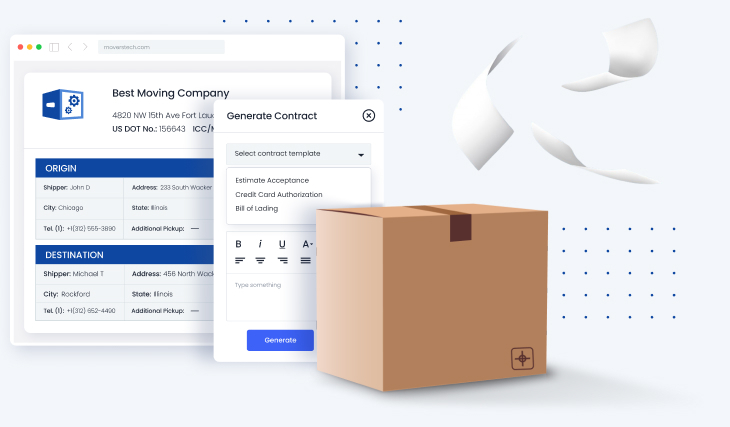
Document templates – estimates, contracts, invoices – can be built and branded to match a company’s existing standards. This matters for companies that have already developed their materials and don’t want to rebuild them inside a new system.
End-to-End Coverage
MoversTech covers the full operational lifecycle:
- lead capture and sales pipeline
- quoting and estimates
- dispatch and scheduling
- job management
- storage billing
- invoicing and payments
The platform is designed so data flows from first contact to final payment without gaps that require manual workarounds or additional tools.
Automation Built on Proven Workflows
Where Supermove combines conditional workflows with AI-assisted behavior, MoversTech focuses on giving operators direct control over how automation behaves.
Many tasks often described as AI – such as follow-ups, task creation, or workflow progression – can be handled through structured, configurable automation.
The difference is not capability, but control.
In MoversTech:
- triggers, actions, and sequences are defined by your team
- workflows remain visible and predictable
- changes can be made without relying on system-defined logic
This is a deliberate design choice. It keeps automation transparent and aligned with how your team actually works.
MoversTech continues to evolve, including AI-assisted capabilities, while maintaining that level of control.
Onboarding and Transition
MoversTech includes structured onboarding as a standard part of the platform. This includes personalized training, preconfigured workflows, and direct support during the transition.
Teams can start with a working setup and adapt it, rather than building everything from scratch.
Bottom line: MoversTech is designed for moving companies that want full control over how their CRM behaves, with configurable automation and workflows that reflect real operations.
Supermove: AI-Assisted, Structured Platform
Supermove’s positioning centers around AI-assisted workflows layered on top of a structured system.
The platform includes:
- conditional (if/then) automation
- AI-assisted follow-ups and communication
- call handling and summaries
- workflow automation across multiple parts of the operation
Automation exists in both platforms. The difference is how much of the system is predefined and how much control the operator has.
Structure as a Feature
Supermove provides built-in workflows, document formats, and system logic that companies can adopt.
This can work well for teams that:
- prefer a predefined structure
- want a system that comes with established processes
The trade-off is that teams may need to adapt parts of their operation to fit the system, rather than shaping the system around their existing workflows.
Because of that broader structure and feature depth, Supermove can also involve a steeper learning curve, especially when implemented across multiple departments.
Bottom line: Supermove is a structured platform with AI-assisted workflows, designed to standardize and streamline operations.
Market Position and Approach
Both platforms are used across the moving industry, but they take different approaches.
MoversTech focuses on flexibility and adapting to how companies already operate.
Supermove focuses on a more structured system, where workflows and processes are more defined upfront.
The difference is not about who has more features, but how the system fits into daily operations.
Different Approach to Building the Product
Supermove is a venture-backed company that has raised significant funding to build and scale its platform.
MoversTech has taken a different approach – built by industry operators and grown through working directly with moving companies.
This difference shows up in how the product evolves.
MoversTech focuses on solving real operational problems based on direct feedback from movers – how jobs are quoted, how dispatch is managed, how billing actually works in day-to-day scenarios. Features are built around practical use cases that teams deal with every day, rather than abstract workflows.
The platform is designed to stay close to how moving companies actually operate, with an emphasis on clarity, usability, and predictable behavior – without unnecessary layers or complexity.

Supermove, on the other hand, is built around a more structured system, with expanding automation and AI-assisted layers.
Neither approach is inherently better, but they reflect different ways of building software.
For some companies, a platform that continuously introduces new layers of automation and abstraction is appealing.
For others, a system built around practical workflows, direct feedback, and clear, predictable behavior – without unnecessary complexity – is a better fit.
Which Platform Is the Right Fit?
MoversTech may be the better fit if:
- your company has established workflows you want to preserve
- you want full control over automation and system behavior
- you prefer flexibility across pricing, dispatch, and billing
- you value predictable pricing without long-term lock-in
- you want a system that adapts to your operation
Supermove may be the better fit if:
- you want AI assisting more of your operations
- you prefer a predefined system structure
- your workflows are relatively standardized
- you are comfortable adapting your process to the system
Comparison Summary
| Category | MoversTech | SmartMoving |
|---|---|---|
| Layout Customization | Fully adapts to operations | Less flexible customization |
| Workflow Flexibility | You define the workflow | More structured workflow |
| AI Implementation | Practical automation where it matters | Heavy AI positioning |
| Visibility into processes | Full transparency and control | More standardized system structure |
| Learning Curve | Easy to adopt and train | Requires more onboarding |
| Pricing Model | Clear and predictable | Less transparent |
| Contracts | No long-term commitment | Often annual agreement |
The Right Question to Ask
The most useful question when evaluating a CRM is not which platform has more features.
It is:
Does the system adapt to how we operate, or do we adapt to how the system works?
Both platforms are built for the moving industry. The better fit depends on how you want your operation to run and how much control you want to keep over it.
Frequently Asked Questions
What is the best CRM for moving companies - MoversTech or Supermove?

It depends on how you want your operation to run. MoversTech is a better fit if you want flexibility, control, customizable workflows, and predictable pricing. Supermove is a better fit if you prefer a more structured system with AI-assisted processes.
How do MoversTech and Supermove differ in automation?
Both support automation, including conditional workflows. MoversTech focuses on fully configurable, transparent automation controlled by your team, while Supermove combines automation with AI-assisted workflows and more predefined behavior.
Which platform is more flexible?
MoversTech is generally more flexible, allowing customization across workflows, documents, layouts, and system behavior. Supermove provides more predefined structures, which can require adapting your processes.
How do pricing models compare?
MoversTech offers predictable pricing with no long-term contracts or forced upgrades. Supermove typically follows a more sales-driven pricing approach, which may be less transparent upfront.
Which platform is easier to implement?
MoversTech is typically easier to adopt for teams that want a system aligned with their current workflows. Supermove can take longer to implement due to its broader structure and system-defined processes.
Do both platforms support AI?
Yes. Supermove places a stronger emphasis on AI-assisted workflows, while MoversTech is adding AI-assisted capabilities while keeping workflows transparent and under operator control.
