

MoversTech and Granot serve different types of moving businesses. MoversTech is built for companies managing their own crews, dispatch, and operations, while Granot is designed for brokers and long-distance coordinators handling subcontractors, tariffs, and regulatory compliance across carrier networks.
The moving industry isn’t monolithic. On one side are moving companies – businesses that own trucks, employ crews, dispatch drivers, manage storage facilities, and execute the physical moves themselves. On the other hand are brokers and booking agents – businesses that receive leads, quote moves, coordinate subcontractors or carriers, and handle the financial and logistical side of matching customers to capacity.
These two operating models require different tools.
MoversTech is built around the operational lifecycle of a moving company: from the first lead through dispatch, crew management, storage billing, payroll, and multi-branch coordination. Granot, one of the longest-tenured platforms in the industry, has historically been the default choice for brokers, booking agents, and long-distance coordinators – operations where affiliate settlements, tariff compliance, and subcontractor financial ledgering matter more than crew dispatch or warehouse management.
Neither approach is better in the abstract. The better fit depends entirely on what kind of moving business you run.
Lead management and sales workflow
Both platforms handle lead intake, estimating, and job conversion. Where they differ is in how that pipeline is structured.
MoversTech is designed around configurable automation sequences. A new lead can automatically trigger an inventory request, followed by a quote, followed by a contract, with each step configured around the company’s own sales logic, timing, and messaging. Status changes, payment received, and job start can all be used as automation triggers. This gives coordinators direct control over how leads move through the pipeline without being locked into a prescribed process.

Granot approaches lead management through a more structured workflow. Its red follow-up alerts and daily task views have been specifically praised by long-tenured users for keeping booking coordinators on top of pending quotes and unconverted leads. The platform’s strength in this area is its reliability for high-volume lead environments – particularly the ones common in brokerage and long-distance booking operations, where coordinators handle dozens of simultaneous leads across multiple carrier relationships.
In practical terms:
- MoversTech suits companies that want configurable, automation-driven pipelines aligned to their own sales process.
- Granot suits brokers and coordinators who need reliable lead tracking and follow-up visibility without complex workflow configuration.
Estimating and pricing
Both platforms offer flexible tariff-based and flat-rate pricing engines — this is not a category where one platform clearly outpaces the other.
MoversTech supports fully configurable tariff structures, with users able to create as many tariff profiles as their operation requires. Estimates can be built around distance, cubic footage, weight-based rates, accessorial charges, fuel surcharges, and local or regional rules. Templates are brandable and customizable, and the estimating workflow is designed to adapt to how the company actually prices — not the other way around.
Granot’s pricing engine has deep roots in the long-distance and brokerage segment, with tariff configuration that includes state and city-level rules, shuttle fees, permit costs, and the rate components that interstate operators commonly need. For companies whose estimates must align with DOT regulatory frameworks, that historical depth is worth evaluating directly.
The meaningful distinction here is less about tariff flexibility and more about documentation compliance. Companies operating in the interstate regulated sector — where estimates need to hold up against DOT audit requirements — should evaluate Granot’s BOL and tariff documentation specifically. Companies that need tariff flexibility without that regulatory documentation layer will find MoversTech’s system fully capable of handling complex, multi-tariff pricing environments.
Dispatch and crew operations
For moving companies that operate their own crews, dispatch is one of the most operationally demanding parts of the business.
MoversTech includes a calendar-based dispatch system with daily, weekly, and monthly views that teams can configure to surface the information most relevant to their workflows. Crews access job details, clock in and out, and generate payroll data through dedicated iOS and Android apps. The system supports multiple crews, multiple locations, and the kind of multi-branch visibility that companies expanding into new markets need.
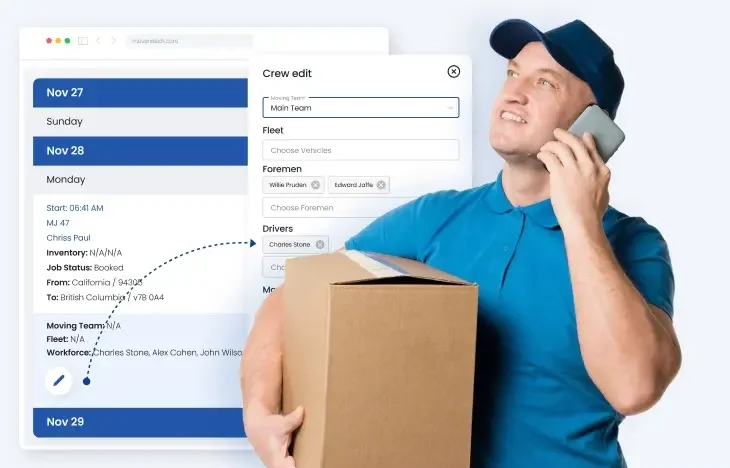
Granot’s offering in this area is more limited in scope – designed primarily around mission management and job assignment rather than the operational depth required to run a multi-crew, multi-location moving company. Its dispatch tools serve the coordination needs of a broker or single-location operator, but are not structured around the complexities of managing crews, trucks, field payroll, and real-time route coordination at scale.
For companies that route their own trucks and pay their own drivers, this difference matters in day-to-day operations.
Storage management
Both platforms include storage management, but the underlying model differs.
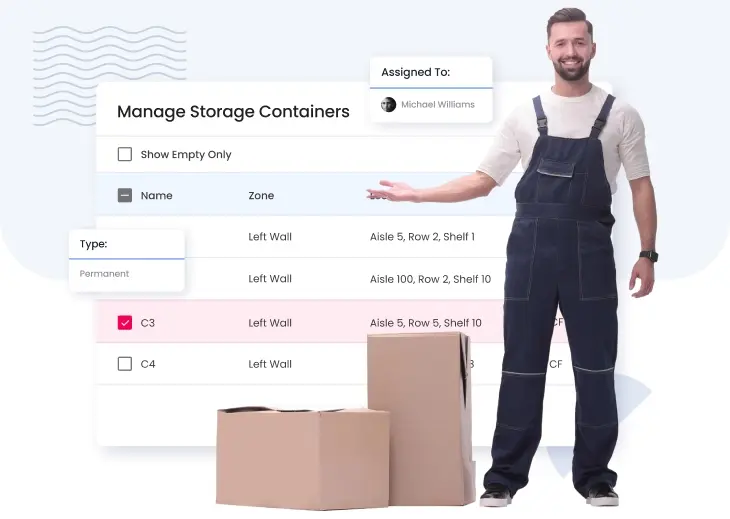
MoversTech handles storage as a core operational module – including warehouse configuration by zone and container, recurring billing cycles, and integration with the broader job workflow. For a moving company that also operates a storage facility, the goal is to connect storage billing directly to the customer’s job history and payment record without separate systems or manual reconciliation.
Granot also offers storage management and has long supported the recurring billing needs common in long-distance storage-in-transit arrangements. This is consistent with its positioning: the storage component is built around the financial coordination needs of a long-distance operator or broker, where storage is often a holding arrangement between pickup and final delivery rather than a standalone warehouse business.
Subcontractors, affiliates, and the broker model
This is the most significant structural difference between the two platforms and the one most relevant to buyers deciding which product to evaluate.
Granot includes built-in affiliate and subcontractor financial ledgering – the ability to track what is owed to and from carrier partners, booking agents, and subcontractors across long-distance moves. It also operates Movers Arena, a shared-truckload load board connecting movers, brokers, carriers, and truck owners for less-than-truckload capacity matching. These features reflect Granot’s roots in the brokerage and long-distance coordination segment of the industry.
MoversTech does not include a load board or affiliate financial ledger because it is not designed for that operating model. Its multi-branch tools, crew payroll engine, and dispatch infrastructure are built for companies running their own operations – not for coordinating third-party carriers or managing inter-company settlements.
If your business model involves buying or selling capacity across a network of carriers and subcontractors, Granot’s infrastructure is purpose-built for that environment. If your business model involves managing your own crews, trucks, and locations, MoversTech’s infrastructure is purpose-built for yours.
DOT compliance and documentation
Long-distance movers and brokers operating in the regulated interstate sector have specific documentation requirements under DOT Title 49 CFR §375.
Granot’s Bill of Lading is structured to comply with these federal regulations, which has made it the default choice for operations where DOT-compliant documentation isn’t optional. For long-distance operators and brokers who need documentation that holds up under regulatory review, this is a meaningful feature.
MoversTech includes digital Bills of Lading with e-signature and full document customization, designed to support both local and long-distance moves with branded templates that match a company’s existing documentation standards. For companies that do not require DOT-specific compliance frameworks embedded in their documentation workflow, the flexibility to configure documents around their own standards is a practical advantage.
Interface and workflow flexibility
Both platforms are fully web-based and accessible across devices. The experience of using them day-to-day differs in ways that reflect their design philosophies.
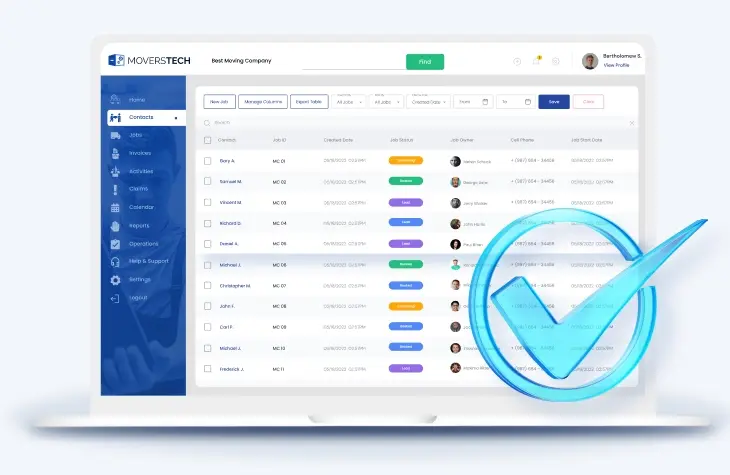
MoversTech emphasizes configurability at a granular level. Job statuses, field names, field types, layout views, and automation sequences can all be adapted to match internal terminology and operational logic. The interface is designed to stay consistent and navigable across desktop, tablet, and mobile, with the same clarity available to a coordinator at a desk and a crew member in the field.
Granot has built its interface around the workflow conventions of the long-distance and brokerage segment. Users who have worked with it for years describe it as efficient for the tasks it was designed to handle – booking coordination, lead follow-up, and invoicing – while also noting that the underlying architecture reflects years of incremental development rather than a modern rebuild from scratch. The platform’s nOMS product, launched in 2022, represents the current generation of the interface.
Which platform is the right fit?
MoversTech may be the better fit if:
- You operate your own trucks and crews, not a brokerage or carrier network
- Your operation spans multiple branches or is actively expanding into new markets
- You want configurable automation aligned to your own sales and dispatch workflows
- You need integrated payroll, crew app, and dispatch coordination
- You prefer flexible, month-to-month pricing without long-term lock-in
- You want a platform that adapts to how your company operates, not the other way around
Granot may be the better fit if:
- You operate as a broker, booking agent, or long-distance carrier coordinator
- Your workflow relies on affiliate settlements and subcontractor financial ledgering
- You need a load board to match capacity across a carrier network
- Your team is large, and unlimited-user pricing represents a meaningful efficiency
Comparison summary
| Category | MoversTech | Granot |
|---|---|---|
| Primary market | Moving companies with own crews and operations | Brokers, booking agents, long-distance coordinators |
| Estimating | Configurable tariff and flat-rate automation | Deep tariff infrastructure by state/city/accessorial |
| Dispatch | Calendar-based, multi-crew, multi-branch | Mission management, single-location orientation |
| Crew Mobile App | iOS and Android with payroll integration | Responsive web access; no native-app ratings confirmed |
| Storage management | Warehouse/zone/container with recurring billing | Storage-in-transit billing for long-distance model |
| DOT BOL Compliance | Customizable digital BOL with e-signature | DOT Title 49 CFR §375.505-compliant BOL |
| Workflow automation | Fully configurable trigger-based sequences | Structured workflow with reliable task alerts |
| Multi-branch support | Yes, including branch-level reporting | Limited; designed for single-entity operations |
| Payroll | Crew time tracking and payroll integration | Payroll tracking available on higher OMS tier |
| Interface | Modern, configurable across desktop and mobile | Web-based; nOMS rebuild launched 2022 |
The right question to ask
The most useful question when evaluating these two platforms is not which one has more features.
It is: What kind of moving business do you actually operate?
If you run trucks, employ crews, manage warehouses, and are building a multi-location operation, you need software built for the operational complexity of running a moving company. If you coordinate capacity, manage carrier relationships, and process the financial side of long-distance moves across a network of subcontractors, you need software built for that model.
Both are legitimate, established approaches. The platforms reflect them.
Frequently Asked Questions
Are MoversTech and Granot direct competitors?

They operate in the same industry but serve different business models within it. MoversTech is designed for moving companies that run their own crews and operations. Granot is designed for brokers, booking agents, and long-distance coordinators. There is overlap for some long-distance moving companies, but the core use cases are different.
Can a long-distance moving company use MoversTech?
Yes. MoversTech supports long-distance moves including tariff-based pricing, customizable BOLs, and cross-border operations. It is used by long-distance operators who run their own crews. Companies that rely heavily on carrier networks, affiliate settlements, or DOT-specific documentation frameworks should evaluate both platforms carefully based on those requirements.
Does Granot work for a growing multi-branch moving company?
Granot's design is optimized for broker and long-distance coordinator workflows. Companies managing multiple branches, their own crews across locations, and integrated payroll and dispatch operations may find MoversTech's infrastructure better suited to those operational needs.
How do their pricing models compare?
Both start at similar entry price points. MoversTech operates month-to-month with no required long-term contracts. Granot offers flat monthly fees with unlimited users on Legacy tiers, which can be cost-efficient for large coordinator teams. Both require a demo to discuss current pricing in detail.
Which platform has better automation?
MoversTech includes configurable trigger-based automation sequences across lead follow-up, job status changes, communications, and billing. Granot includes structured task alerts and follow-up indicators well-suited to booking coordinator workflows. The more flexible, programmable automation layer is in MoversTech; the more structured, reliable alerting for high-volume lead tracking is in Granot.
