

The impact of inflation on moving costs extends well beyond fuel. Labor, maintenance, equipment, insurance, and claims all put pressure on moving company margins. The response is greater operational control: accurate pricing, efficient dispatch, complete billing, and clear reporting across every job.
The cost of running a moving company has risen across nearly every part of the operation. Fuel is more expensive, labor remains the largest major cost, maintenance expenses are climbing, and equipment and insurance continue to put pressure on margins.
The important distinction is that higher revenue does not necessarily mean higher profitability. A company can book more moves and still lose margin if rates, crew hours, mileage, accessorial charges, storage billing, or claims are not managed closely.
That makes the impact of inflation on moving costs an operational problem as much as a pricing problem. Moving companies need to know where costs are changing, what each job is actually costing them, and where processes can be adjusted before lost margin becomes visible on the P&L.
What is the impact of inflation on moving costs in 2026?
Inflation increases the cost of completing a move by raising the price of the inputs moving companies depend on, including labor, fuel, equipment, maintenance, insurance, and replacement goods. If job pricing and operations do not adjust at the same pace, the difference comes directly out of margin.
The latest American Transportation Research Institute benchmark illustrates the pressure. ATRI’s 2026 report found that the industry-average cost of operating a truck reached $2.336 per mile in 2025, up 3.4% year over year and the highest level in the report’s history. Costs excluding fuel increased 4.2% to $1.854 per mile.
For movers, four cost areas deserve particular attention:
- Labor and crew time
- Fuel and transportation
- Trucks, equipment, repairs, and maintenance
- Insurance, damage, and claims
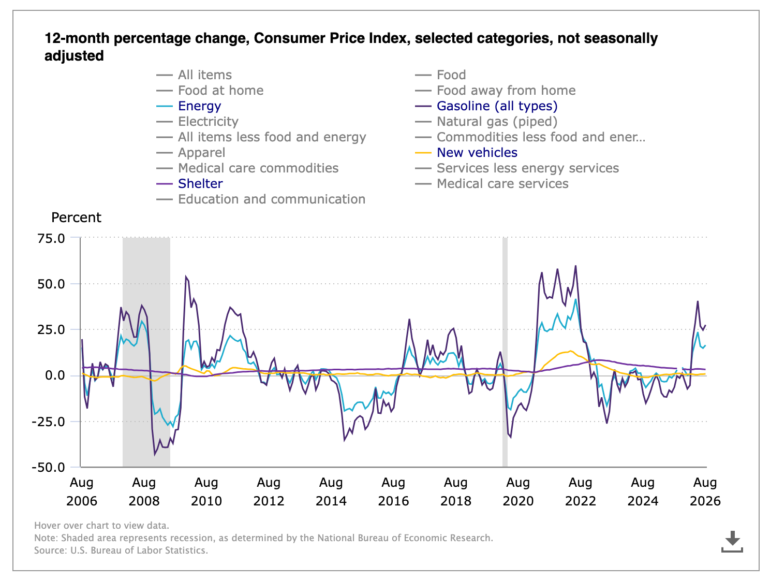
Moving company cost pressures at a glance
ATRI’s $2.336 benchmark describes 2025 trucking operations, even though the report was published in 2026. EIA’s September 2026 Short-Term Energy Outlook provides a more current view of fuel conditions, forecasting the U.S. retail diesel price to average $5.07 per gallon in 2026.
Moving companies are feeling cost pressure across nearly every part of the operation. ATRI’s latest data puts the average truck operating cost at $2.336 per mile for 2025, up 3.4% year over year. Fuel added another $0.482 per mile, and EIA forecasts U.S. retail diesel to average around $5.07 per gallon in 2026, making mileage and route efficiency even more important. Repair and maintenance costs also rose 8.6% year over year, while truck and trailer costs averaged about $0.404 per mile and insurance premiums about $0.106 per mile. For movers, the takeaway is straightforward: higher operating costs make efficient crew scheduling, accurate pricing, vehicle utilization, and tighter control over every job increasingly important to protecting margins.
How do higher fuel prices affect moving company margins?
Higher fuel prices increase the cost of every mile driven, making distance, routing, deadhead mileage, and job pricing more important to margin.
This is especially relevant in 2026 because the fuel cost contained in ATRI’s latest operating-cost benchmark reflects 2025 conditions. EIA’s September forecast puts the 2026 average retail diesel price substantially higher, at $5.07 per gallon. For a mover operating several trucks every day, that difference compounds quickly. Longer jobs, multi-stop routes, repositioning trucks, and inefficient dispatch all consume fuel that has to be recovered somewhere.
The answer is not simply to raise every estimate by the same percentage. Moving companies need pricing rules that account for the characteristics of the job and a dispatch process that keeps unnecessary mileage under control.
With rule-based pricing, rates and relevant charges can be applied consistently instead of depending on manual adjustments or individual memory. That gives management more control over how changing operating costs are reflected before a job is booked.
Which is the largest operating expense for a truck?
Driver compensation is the largest single operating cost in ATRI’s latest benchmark.
Driver wages averaged approximately $0.818 per mile in the report’s 2025 dataset, while driver benefits added another $0.210 per mile. Together, driver compensation reached about $1.028 per mile.
For moving companies, the implication is straightforward: crew time needs to be used deliberately.
A scheduling problem does not only create inconvenience. It can mean paid hours spent waiting, unnecessary travel between jobs, overtime that could have been avoided, or a truck and crew being underused for part of the day.
That is why operational efficiency matters more than simply trying to reduce labor expense. Centralized scheduling and dispatch gives teams a clearer view of jobs, crews, trucks, timing, and changes so they can use available capacity more effectively.
How are maintenance and equipment costs affecting movers?
Higher maintenance and equipment costs make fleet utilization and cost visibility increasingly important.
ATRI reported that repair and maintenance costs increased 8.6% year over year in its latest dataset, one of the largest increases among major operating-cost categories.
For a moving company, the question is therefore not only what it spends on its fleet. It is whether each truck is being used productively enough to justify that spend.
A company looking only at total monthly expenses can miss that distinction. Management needs enough operational visibility to compare jobs, mileage, utilization, revenue, and related costs rather than treating every truck or branch as equally productive.
This is where reporting becomes part of margin management. When sales, scheduling, operations, and billing data sit within the same system, operators have a clearer basis for deciding where resources are being used well and where processes need attention.
How do inflation and labor pressure affect moving claims?
Inflation can raise the cost of claims because damaged or lost goods may cost more to repair or replace. Staffing pressure can add another layer of operational risk when documentation, communication, or claim follow-up becomes inconsistent.
The cost of a claim is not limited to the damaged item. Office time, customer communication, supporting documents, status tracking, and resolution all consume resources.
That makes consistent documentation important. A claim managed through scattered emails, messages, spreadsheets, or individual memory is harder to track than one connected to the customer’s move record.
MoversTech keeps claims management within the broader CRM workflow, giving teams one place to record the issue, maintain documentation, track progress, and keep the claim tied to the relevant customer and job.

How can moving companies protect margins as costs rise?
Moving companies can protect margins by improving control over pricing, crew utilization, billing, claims, and reporting rather than relying on across-the-board cost cutting.
The objective is to reduce the operational gaps between what a job should earn and what the company ultimately keeps.
Where does a moving CRM fit into inflation management?
A CRM does not control diesel prices, wages, insurance premiums, or the price of replacement parts. Its role is to give a moving company more control over the operational decisions affected by those costs.
That distinction is important.
| Margin pressure | Operational response | How MoversTech supports it |
|---|---|---|
| Changing job costs |
|
|
| High labor cost |
|
|
| Manual administrative work |
|
|
| Missed charges |
|
|
| Claims exposure |
|
|
| Limited cost visibility |
|
|
| Different processes across companies |
|
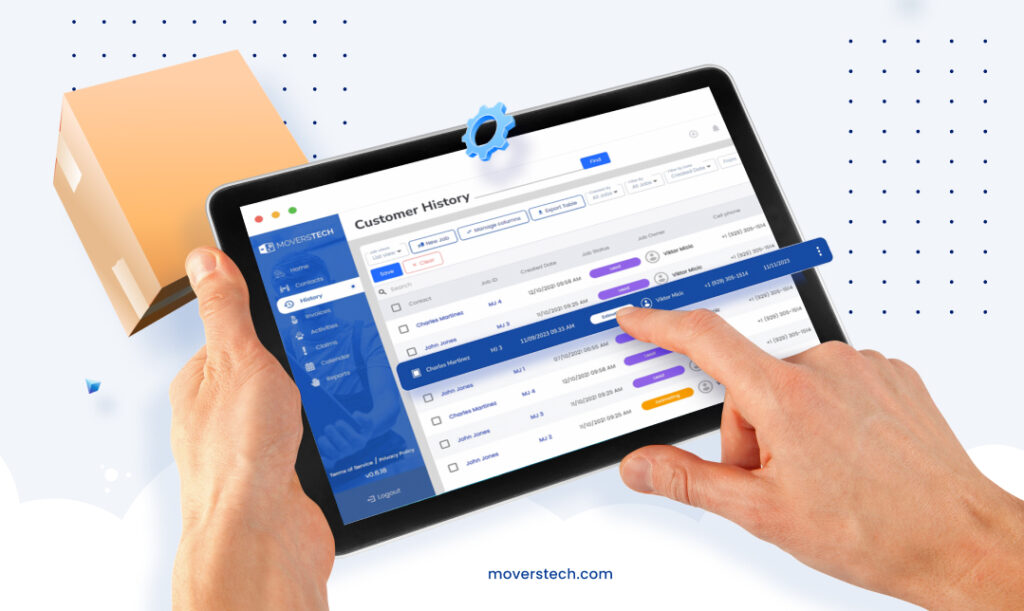
MoversTech is an end-to-end CRM built specifically for moving companies, rather than a generic CRM adapted to the moving industry. Sales, operations, dispatch, claims, storage, billing, and reporting can be managed within the same platform while workflows remain customizable to the needs of the company.
The purpose of that integration is practical: fewer handoffs between systems, less repetitive administrative work, and greater visibility from the initial lead through the final invoice.
Better control matters more when costs are unpredictable
The impact of inflation on moving costs cannot be removed by software. Fuel, wages, maintenance, equipment, insurance, and claims will continue to change.
What moving companies can control is how quickly their operation responds.
Accurate pricing helps prevent jobs from being booked on outdated assumptions. Better dispatch protects expensive crew hours. Connected billing reduces missed revenue. Claims workflows improve documentation. Reporting gives management a clearer view of what is happening across the business.
MoversTech brings those functions together in a moving-specific CRM that is fully flexible and customizable, backed by structured onboarding, real human support, predictable pricing, and no long-term contracts. Companies retain control over how they work instead of being forced into a one-size-fits-all process.
To see how MoversTech can fit your existing operation, schedule a private demo.
Frequently Asked Questions
What is the impact of inflation on moving costs?

Inflation increases the cost of the inputs required to complete a move, including fuel, labor, equipment, maintenance, insurance, and replacement goods. If a moving company's pricing and operations do not adjust at the same pace, those higher costs reduce profit margin.
What is the largest expense for operating a truck?
Driver compensation is the largest major operating expense in ATRI's latest benchmark. Driver wages and benefits totaled approximately $1.028 per mile in its 2025 dataset, compared with an overall operating cost of $2.336 per mile.
How can moving companies respond to rising fuel costs?
Moving companies can review pricing rules, reduce unnecessary mileage, improve dispatch efficiency, and monitor job profitability more closely. The goal is to ensure that higher transportation costs are reflected in both how work is priced and how efficiently it is completed.
Can a moving CRM reduce inflation?
No. A CRM cannot change external costs such as fuel, wages, insurance, or equipment prices. A moving-specific CRM can help a company respond to those costs through more consistent pricing, scheduling, dispatch, billing, claims management, automation, and reporting.
How does MoversTech help moving companies protect margins?
MoversTech connects lead management, pricing, scheduling, dispatch, claims, storage, billing, and reporting within one customizable system. This gives moving companies more control over crew utilization, pricing consistency, administrative work, revenue capture, and operational visibility as costs change.
