
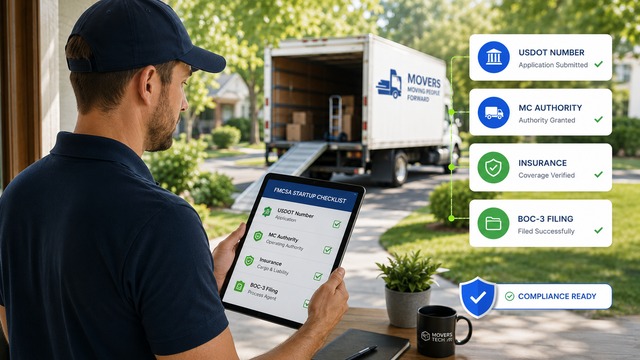
To run an interstate moving company, you need a USDOT number, which is free, and a for-hire operating authority — an MC number that costs a one-time, non-refundable $300. Household goods carriers must also file public liability and cargo insurance and designate a process agent through a BOC-3 filing. Everything runs through FMCSA’s Unified Registration System, and activation typically takes 20–30 business days.
If you want to move customers across state lines, you cannot legally do it without federal registration — and knowing how to get a USDOT number is the first step. Most new moving companies are surprised by how much of the setup is paperwork rather than trucks and crews. This guide walks through exactly what interstate movers need, what each piece costs, and how long the whole process takes.
What moving companies must register with FMCSA
Here is everything an interstate household goods mover files, with current costs.
| Requirement | Cost |
|---|---|
| USDOT number | Free |
| Operating authority (MC number) | $300, one-time, non-refundable |
| BOC-3 process agent | ~$20–40 |
| Public liability insurance (BMC-91) | Premium varies |
| Cargo insurance (BMC-34) | Premium varies ($5,000/vehicle, $10,000/occurrence) |
| UCR registration | Annual fee by fleet size |
Do moving companies need a USDOT number?
Any company operating commercial vehicles in interstate commerce needs a USDOT number, and that includes movers hauling household goods between states. The number is a federal safety identifier the FMCSA uses to track your inspections, crashes, and compliance reviews.
Intrastate movers — companies that only move customers within a single state — are a different case. Many states still require a USDOT number for intrastate carriers, but the rules vary by state, so confirm with your state’s department of transportation. If you are only now setting up the business, it is worth reading how to start a moving company from day one so registration lines up with the rest of your launch.

USDOT number vs MC number: what’s the difference?
These two are often confused, and movers need both. A USDOT number is your safety identifier — it is free and identifies your company to the FMCSA. Operating authority, issued as an MC number, is separate: it is federal permission to operate as a for-hire carrier transporting regulated goods across state lines.
A moving company that carries household goods for the public in exchange for payment is a for-hire carrier, so it must hold operating authority on top of its USDOT number. The USDOT number says who you are; the MC number says you are allowed to do the job for money across state lines.
How to get a USDOT number and MC authority
New applicants complete everything in one place through the FMCSA’s Unified Registration System (URS), which issues the USDOT number and processes operating authority together. Here is the sequence:
- Register through the URS. Create your application online; a credit card is required for the authority fee.
- Get your USDOT number. It is issued as part of the registration — no separate fee.
- Apply for operating authority. Request Motor Carrier of Household Goods authority and pay the $300 filing fee, which is non-refundable.
- File a BOC-3. A registered process agent designates a legal contact in every state, usually through a blanket agent for about $20–40, filed the same day.
- File your insurance. Your insurer submits the BMC-91 (public liability) and, for household goods, the BMC-34 (cargo coverage of $5,000 per vehicle and $10,000 per occurrence) directly to the FMCSA.
- Clear the vetting period. A protest window of roughly 10 business days runs before authority is granted; from application to active authority, plan on 20–30 business days.
If you already hold a USDOT number, you file the appropriate OP-1 operating authority form instead of starting fresh. You can confirm every requirement on the FMCSA’s official registration process before you pay anything.
What insurance do interstate movers need?
Household goods movers must file two insurance forms before authority activates: public liability (BMC-91) for bodily injury and property damage, and cargo insurance (BMC-34) covering $5,000 per vehicle and $10,000 per occurrence. Both are filed electronically by your insurance carrier, not by you — and your authority will not activate until they are on file.
Choosing the right coverage matters beyond the minimum, because underinsuring exposes you on every claim. It helps to understand the insurance a moving company actually needs before you bind a policy, so you file coverage that protects the business rather than just clearing the federal minimum.
Staying compliant after you get authority
Getting registered is the start, not the finish. Interstate movers carry ongoing obligations:
- Update your MCS-150 every two years to keep your USDOT number active — miss it and your registration can be deactivated.
- Renew your UCR annually. The Unified Carrier Registration fee is based on fleet size and is due each year.
- Pass the New Entrant Safety Assurance Program. New interstate carriers are monitored for 18 months and must pass a safety audit to keep their authority.
- Meet household goods consumer rules. Interstate movers must give customers the required “Your Rights and Responsibilities When You Move” booklet, maintain a published tariff, and issue proper paperwork on every job.
Those last obligations are where day-to-day operations meet compliance. Your rates have to follow moving tariff requirements, and every move needs a document trail — starting with a clean bill of lading on every job. Building those into a system from the start keeps compliance from becoming a scramble later.

What about intrastate moves?
If your company only moves customers within one state, federal operating authority usually does not apply — but a USDOT number often still does. Many states require interstate-style registration for intrastate carriers, and most require their own state-level moving license or authority on top of it. Because the rules differ sharply from state to state, confirm your specific requirements with your state department of transportation before you take your first paid job.
Set your moving company up to run the right way
Federal registration is the foundation, but once you know how to get a USDOT number and operating authority, the real work is running a compliant operation every day — accurate tariffs, signed documents, and a clear record on every move. MoversTech CRM keeps that side organized, with contracts, e-signatures, and job records in one place so your paperwork holds up to scrutiny. Book a demo to see how it fits your workflow from day one.
Frequently Asked Questions
How much does it cost to get authority to run a moving company?

Operating authority (the MC number) costs a one-time, non-refundable $300 per authority. The USDOT number itself is free. Add roughly $20–40 for a BOC-3 process agent filing, plus your insurance premiums and an annual UCR fee based on fleet size.
How long does FMCSA registration take?
From application to active authority, expect about 20 to 30 business days. That includes a protest period of roughly 10 business days, after which activation depends on how quickly your insurer files the BMC-91 and BMC-34 forms and your BOC-3 is on record.
Do local movers need a USDOT number?
Often, yes. Movers operating only within one state are regulated at the state level, but many states still require a USDOT number for intrastate carriers. Confirm the exact rule with your state department of transportation.
What insurance does an interstate mover need to file?
Household goods movers must file public liability insurance (BMC-91) and cargo insurance (BMC-34), with cargo coverage of $5,000 per vehicle and $10,000 per occurrence. The insurer files both electronically, and authority does not activate until they are on file.
